
Does the Bible Allow Women Pastors?
We see women pastors all over the modern Church.
You may be familiar with the Southern Baptist convention and Saddleback Church on this topic of women preachers in church leadership.
We see female pastors on TV, and in Churches all around the world. But are woman pastors biblical? Can a woman be a pastor?
- Does God call woman pastors and send out female pastors to do His work in The Church?
- Are there any bible verses supporting female pastors?
- Should Christian women be pastors?
We're going to look at the Scriptures, not culture for the answers to the question on whether a woman can be a pastor.
Scriptural Arguments for and Against Women Pastors From Across The Web
| Position | Key Scriptures | Interpretation | Key Theological Groups |
|---|---|---|---|
| ✅ Women Can Be Pastors | 1. Galatians 3:28 – "There is neither Jew nor Greek, slave nor free, male nor female, for you are all one in Christ Jesus." 2. Acts 2:17–18 – The Holy Spirit is poured out on all believers, regardless of gender, and they will prophesy. 3. Romans 16:1 – Phoebe is described as a deacon, with some interpreting this as a leadership role in the church. 4. Romans 16:3 – Priscilla, with her husband Aquila, is noted as co-workers with Paul, teaching Apollos. 5. 1 Corinthians 11:5 – Women praying and prophesying in public meetings, with the assumption of being in leadership. | 1. Galatians 3:28 is viewed as a radical statement of equality, affirming women’s participation in ministry. 2. Acts 2:17-18 is often cited to show that the gifting of the Holy Spirit is not gender-specific. 3. The example of Phoebe and Priscilla is used to argue that women held prominent roles in early church leadership and teaching. | - Many Evangelical feminists - Progressive Protestant churches - Pentecostal/Charismatic churches (especially in favor of women in ministry roles) - Some branches of the Methodist Church |
| ❌ Women Should Not Be Pastors | 1. 1 Timothy 2:12 – "I do not permit a woman to teach or to exercise authority over a man; rather, she is to remain quiet." 2. 1 Corinthians 14:34–35 – "Women should remain silent in the churches. They are not allowed to speak, but must be in submission, as the Law says." 3. 1 Timothy 3:2 – "Now the overseer is to be above reproach, the husband of but one wife..." (implying a male leader). 4. Titus 1:5–6 – "An elder must be blameless, the husband of but one wife..." (again, male leadership emphasized). | 1. 1 Timothy 2:12 and 1 Corinthians 14:34-35 are often cited as explicit prohibitions against female leadership in the church. 2. 1 Timothy 3:2 and Titus 1:5-6 are viewed as qualifications that implicitly or explicitly exclude women from the office of overseer or elder, since they reference the "husband of one wife." | - Complementarian churches (e.g., Southern Baptist Convention, Reformed churches) - Roman Catholic and Orthodox churches (which reserve the pastoral role for men) - Some Evangelical churches (especially conservative groups) |
Which is correct? Notice those scriptures that seem for are mostly descriptive, but those that are against are prescriptive. Do you know why? The Lord Himself is against woman pastors and preachers in the House of God, so His Word against this are commandments or prescriptive (Isaiah 3:12, Rev 2:20-23, 1 Cor 14: 34-37) More on this later.
Let's look at the Scriptures now to answer the question: Can Women be Pastors in the Church?
Here's a great quiz to try out!
We'll look at several statistics on this page, but here's one based on Church attendance based on the gender of the pastor.
| Pastor Gender | Average Weekend Attendance (Adults) |
|---|---|
| Male | ~103 adults |
| Female | ~81 adults |
Source: Barna Group reports that male pastors lead congregations averaging 103 adults, while female-led ones average 81. This simply shows that less people regularly attend female led Churches. Where and how does the Great Commission from The Lord Jesus factor in here?
Here's a similar finding from The National Congregations Study 1998-2018
| Pastor Gender | Average Congregation Size |
|---|---|
| Male | ~120 people |
| Female | ~60 people |
This may just be correlation and not causation however, so let's go into the Biblical text
Just so we are on the same page, here are Scriptures that are clearly against woman pastors and women preachers in the House of God.
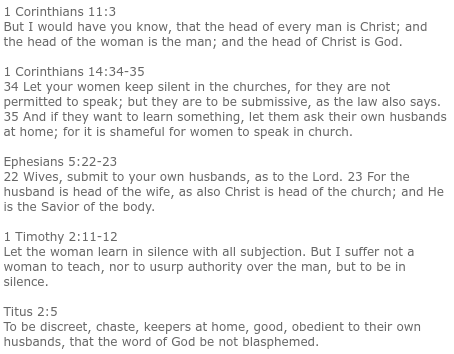
Just in case a woman says the Lord called me to preach in the church and be a pastor, here's the Scripture that utterly proves this woman to be of a contrary spirit.
1 Corinthians 14: 34-37
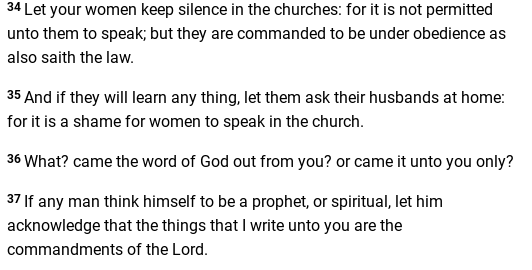
Did you notice that this is the Commandment of The Lord as 1 Corinthians 14:37 says! This is not Paul's opinion. This is what The Lord God Almighty says!
This is not speaking about women not speaking in the Church altogether because 1Corinthians 11 shows how women are to conduct themselves when praying or prophesying. This text however is in reference to judging prophecies which is comparative to authoritative teaching which is reserved for men.
Again, the question posed by the devil was "Did God say" and we know the woman was deceived. So in the judging of prophetic words and in the authoritative teaching that follows such judgments and in authoritative teaching in The Church in general, the women are to be silent.
Someone might say that this is all the traditions of man and stem from male chauvinism. And to that the answer is NO.
Try our free quiz on woman pastors and what the Scriptures share - Scriptures will show up in the answer section. Tap or click to get started!
What the Bible Says About Women Pastoring
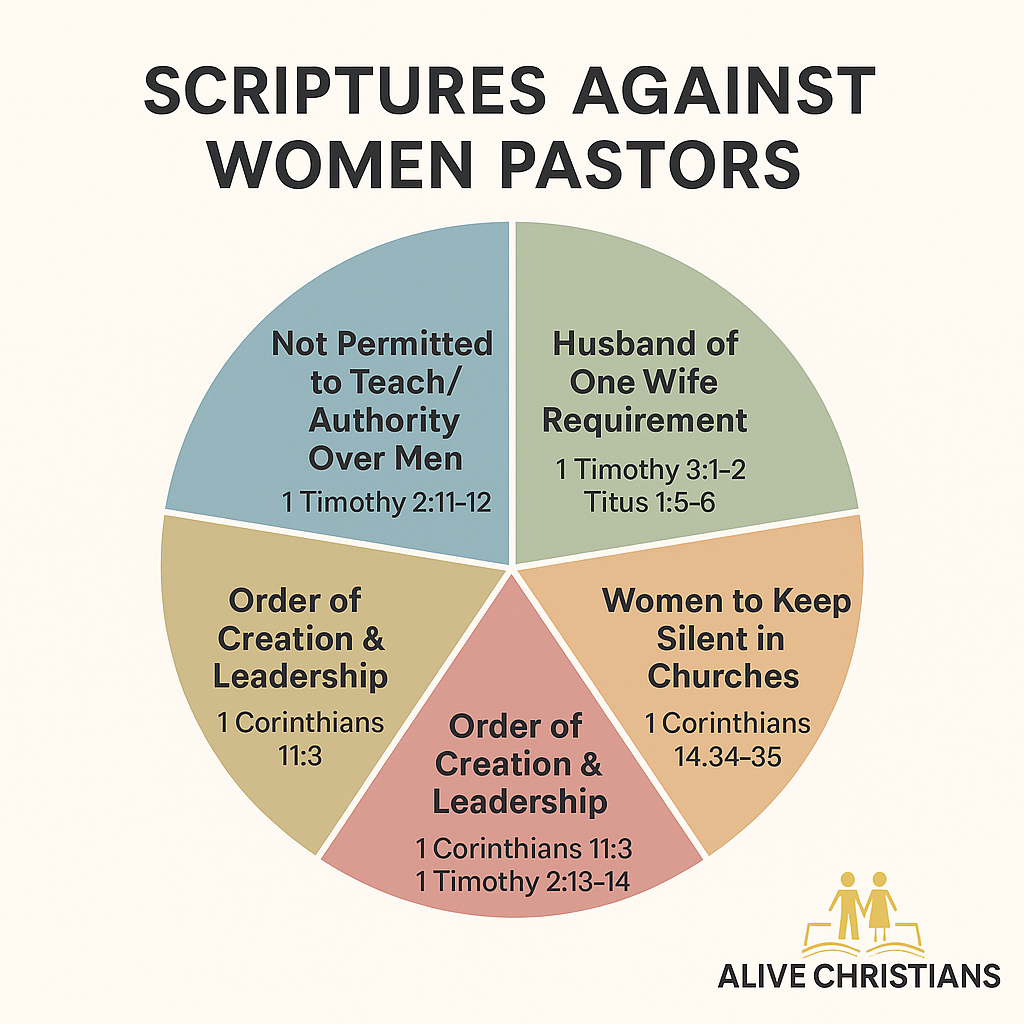
Let me bring your attention to a particular line in the above text that says: but they are commanded to be under obedience as also saith the law.
Lots of people say that there is no law that says that the woman must be under obedience.
But this is not true. Most people go to Exodus, Deuteronomy or Leviticus to find the law, but the first five books of the Bible are called the Law, and the Lord Jesus Himself refers to the book of Psalms as the Law as well when He mentions that the Law says ye are gods which is actually in Psalm 82:6. In the Time of The Lord Jesus it seems like there were 2 parts to the Old Testament, the Law and the Prophets.
But in any event, the first five books of the Bible are referred to closely as The Law.
To find this command that they are to be under obedience as also saith the law, we have to go to the Book of Genesis.
It's important here to note, that in the Greek. for "they are commanded to be under obedience", the Apostle Paul uses words that connote that they are to willingly subject themselves, and not that the subjection is to come from an external entity. In other words, the women are commanded by God to subject themselves. Again, this establishes the value of the woman even in her subjection which the Apostle Peter in 1Peter 3:4 talks about when addressing the woman's beauty.
But let it be the hidden man of the heart, in that which is not corruptible, even the ornament of a meek and quiet spirit, which is in the sight of God of great price. 1 Peter 3:4So women being silent in the Church in judgment and teaching is of great price to God.
Another way of saying this is that this is of great sacrificial impact. And I guess the reverse is likely true, that disobedient, unsubmissive women are of great harm and insult to the Kingdom of God. The Lord Jesus' vehement opposition to it in Revelation 2 corroborates this fact.
So now that we've shown that this is willing subjection on the woman's part and that her meek (ability with restraint) and quiet spirit is of great value to God, let's look at the passage in the law found in Genesis that commands her willing submission to be under obedience. Ready?
Genesis 3:16 Unto the woman he said, I will greatly multiply thy sorrow and thy conception; in sorrow thou shalt bring forth children; and thy desire shall be to thy husband, and he shall rule over thee.
God told the woman that she will have a desire to rule her husband, but the man shall rule over her. It doesn't look at first that she is commanded to subject herself unto her husband so that her husband rules over her, but to see that we have to compare it to a parallel text with sin and Cain.
If you do well, will you not be accepted? And if you do not do well, sin lies at the door. And its desire is for you, but you should rule over it.” Genesis 4:7
So the command spoken directly to woman by inference is that your desire is to have, control, or rule over your husband, but he should rule over you.
In other words, The Lord told the woman (paraphrasing) it is my will that he rules over you, so willingly subject yourself. Hence, he (the man, your husband) should rule over you.
Does the bible allow a woman to be a preacher in The House of God, The Church? The answer is a clear no.
Scripture clearly show that the overseer/pastor is to rule His own house well and have his children under subjection. Look at these pieces of research that clearly shows the design of the man in this endeavor
Table: Parenting Challenges by Gender (Pew Research)
| Challenge Type | Percentage Women Reporting | Percentage Men Reporting |
|---|---|---|
| Parenting is tiring | 47% | 34% |
| Parenting is stressful | 34% | 24% |
What does this mean? Men are less stressed out or taxed by overseeing than women are. This shows the design of God.
And if this wasn't enough evidence that God has given the woman a supporting role, but the foundational and overseeing role to the man, look at this and ask yourself who would be the most effective and aptly designed gender for the role of pastor in The House of God:
Table 1: Increased Risk for Children from Single-Mother Households (FixFamilyCourts.com)
| Outcome / Risk Factor | Increased Likelihood (Compared to Single-Father/Unbroken Homes) |
|---|---|
| Suicide | 5× more likely |
| High school dropout | 9× more likely |
| Substance abuse (drugs/alcohol) | 10× more likely |
| Committing rape | 14× more likely |
| Imprisonment | 20× more likely |
| Running away from home | 32× more likely |
As you can see, single mother households have 5X more suicides than single father households, 9X more dropouts than single father households and 20X more imprisonment rates than those run by single fathers or households with both father and mother.
Look at the rape and drug use numbers!
Clearly, there is an inherent design in the man for order, direction, and overseeing that the woman who was designed by God to help the man, does not have. And it is these qualities that God requires the pastor to have, clearly showing that only biblically qualified men can fill the role of pastor.
This does not belittle the wonderful work of women however, especially when faced with being a single parent.
Table 2: Contribution of Single-Mother Households to Negative Outcomes (Fix Family Courts)
| Outcome Category | % Attributed to Single-Mother Households |
|---|---|
| Teen pregnancies | 70% |
| Child murders | 70% |
| Filicide cases (parent killing child) | Majority of cases |
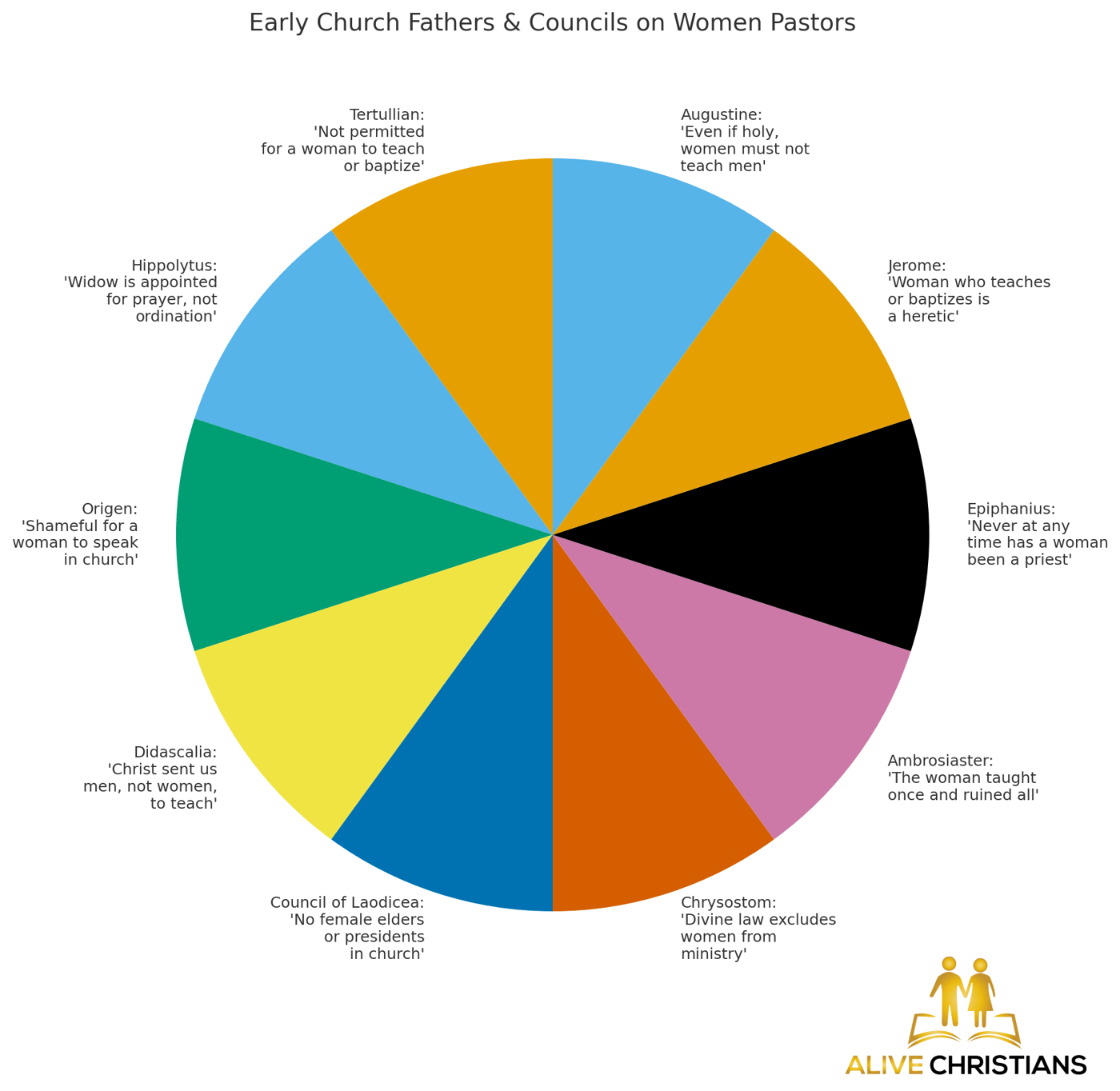
See the teachings of the early Church fathers on this topic:
| Author / Council | Quote | Source / Context |
|---|---|---|
| Tertullian (c. 155–220) | “It is not permitted for a woman to speak in the church, nor to teach, nor to baptize, nor to offer, nor to claim to herself a share in any masculine function-least of all in priestly office.” | On the Veiling of Virgins, ch. 9 |
| Hippolytus (c. 170–236) | “When a widow is appointed, she shall not be ordained… Ordination is for the clergy… The widow is appointed for prayer, and that is all.” | Apostolic Tradition, §11 |
| Origen (c. 185–253) | “It is shameful for a woman to speak in church; the law itself forbids her.” | Commentary on 1 Corinthians 14:34 |
| Didascalia Apostolorum (3rd c.) | “We do not permit our women to teach in the Church, but only to pray and hear… Christ sent us men, not women, to teach the people.” | Didascalia Apostolorum, ch. 3 |
| Council of Laodicea (c. 363–364) | “It is not permitted for those women called presbytides [female elders] or female presidents to be appointed in the Church.” | Canon 11 |
| St. John Chrysostom (c. 347–407) | “The divine law has excluded women from the ministry. She may not speak in the church, nor teach, nor baptize, nor offer, but she is to be in subjection.” | Homily on 1 Corinthians 14 |
| Ambrosiaster (late 4th c.) | “The woman taught once and ruined all. On this account therefore she ought not to teach.” | Commentary on 1 Tim. 2:12 |
| Epiphanius of Salamis (c. 315–403) | “Never at any time has a woman been a priest… there is an order of deaconesses… but this is not for priestly office.” | Panarion, 79:3 |
| St. Jerome (347–420) | “A woman who presumes to teach or to baptize is not a teacher but a heretic.” | Epistle to Evangelus, Letter 146 |
| St. Augustine (354–430) | “Even when a woman is learned and holy, she must not presume to teach men in the Church or exercise authority over them.” |
Women As Pastors Put On That Which Pertains To The Man and This Is An Abomination According To Deuteronomy 22:5
In witness to the Genesis "he shall (should)rule over you" Scripture, the Apostle Paul shares that women are to be under obedience to their husbands and their husbands should rule over them. This again shows that the woman cannot be a pastor, for the pastor must be the husband of one wife and rule his own house well and the woman is not to be in authority over her husband, but in submission.
For the woman to be a pastor she would have to put on that which pertains to a man and this is an abomination to the Lord as Deuteronomy 22:5 clearly states.
This is why the Lord Jesus, The Almighty Himself is so against this in Revelation 2. It's not only sin but an abomination which is worse.
20 Notwithstanding I have a few things against thee, because thou sufferest that woman Jezebel, which calleth herself a prophetess, to teach and to seduce my servants to commit fornication, and to eat things sacrificed unto idols.21 And I gave her space to repent of her fornication; and she repented not. Revelation2:20-21Just in case the sacrifice to idols mentioned there seems unrelated to this topic of woman pastors and woman preachers in the House of God, let me share this with you.
First of all, The Lord basically says woman twice in that text. We all know Jezebel was King Ahab's wife in Scripture who usurped her husbands authority and led people astray. So there was no need for the Lord to say woman in front of Jezebel, but He did. This is like "woman woman" . We see this sort of thing with "verily, verily". He's emphasizing "woman" in the context here.
Next, the way how you present your body to God is a sacrifice. Remember Romans 12:1:
"I beseech you therefore, brethren, by the mercies of God, that ye present your bodies a living sacrifice, holy, acceptable unto God, which is your reasonable service."The Word of God can be considered bread, or meat. So the word coming out of a sacrifice that is not acceptable to God is one that is acceptable to the devil who is against all things God. So those who eat the food(words) sacrificed to idols (body presented in disobedience to God) is eating food in contradiction to God and this causes them to go astray to follow after other gods which the text in Revelation above references as fornication. (fornication is idolatry). See Jeremiah 3 also.
But let's look at a hotly debated topic in Christendom as it will be linked to Jezebel, Asherah and women pastors in the House of God. This is in reference to the greek word used by the Apostle Paul in 1 Timothy.
One very interesting thing to note concerning the Asherah cult is that the Apostle Paul uses a Greek word in 1 Timothy 2:12, authentein, which is not used elsewhere in Scripture. Scholars have long debated its meaning because of its rarity. In the Greek, however, the term is associated in certain contexts with cultic practices and ritual violence, including castration as a form of spiritual renunciation (see Bauer, A Greek-English Lexicon of the New Testament, 1929).
Historical studies of the Asherah cult indicate that eunuchs and women often served as priests, exercising authority in religious rites. Paul’s prohibition of women teaching men or exercising authority over men in the church can thus be understood as a spiritual safeguard: a woman in such a position could, in effect, symbolically “castrate” the men, redirecting their God-given masculine authority away from its proper use (1 Timothy 2:12; cf. Eastern Christian interpretations such as St. Jerome, Commentarius in Epistulam ad Timotheum, circa 5th century).
Scholars also note that authentein in earlier ascetic and Gnostic contexts involved ritualized renunciation of the body’s natural desires, sometimes through extreme measures like castration (Baur, Paulus der Apostel, 1863; Lightfoot, St. Paul’s Epistles to the Corinthians, 1868). Paul emphasizes gender roles to preserve masculine leadership, ensuring that men do not lose their masculine desires, and exercise their God-given strength and authority for the glory of God rather than surrender it.
How do we know that men lose their masculine drives for leadership and authority when women rule or have authority over men? In Isaiah 3:6 during the time when women ruled over them men behaved like this:
Isaiah 3:6-7 Then a man shall take hold of his brother of the house of his father, saying, Thou hast clothing, be thou our ruler, and let this ruin be under thy hand:7 In that day shall he swear, saying, I will not be an healer; for in my house is neither bread nor clothing: make me not a ruler of the people.
This is a clear depiction of effeminacy among the men where no man wants to take the lead or bear the weight of the responsibility that God gave to them. The men had been effectively castrated. And this is in tandem with what the Apostle Paul was referring to when he used the word authentein.
This practice in the Asherah cult reflects a removal of gender distinction. The biblical narrative foreshadows this dynamic: Isaiah 3:12 states that God will “take away from the men their stay and their staff, the mighty man and the judge,” and that women will rule over them, leading to social and spiritual decline. Similarly, King Ahab ceded his authority to Jezebel (1 Kings 21), in part because her Asherah worship represented the inversion of natural gender hierarchy, resulting in the demise of masculine drive, desires and leadership in Israel.
This is why it is forbidden and why the Apostle Paul confirms this when he refers this in 1 Corinthians 14 as the Lord's commandment.
Scriptures say this about the Lord's commandment;
1 John 5:2 By this we know that we love the children of God, when we love God and keep His commandments.
So we love the children of God by keeping His commandments. So how do women love the men? By keeping the Lord's commandment concerning women being silent and learning at home and not teaching and usurping the authority over the men. Because to do otherwise is to cause the men (especially those who are ignorant) to cede their God-given drive, desires and leadership just as Adam did in the garden. It is violence done to men.
Here's why. Another parallel Scripture in Proverbs 31 says do not give your strength unto women nor your ways to do those who destroy kings.
The word used there for destroy is machah in Hebrew.
Hebrew Word: מָחָה (machah)
Basic Meaning:
The root machah generally means “to wipe out,” “erase,” “blot out,” “destroy,” or “obliterate.”
It is often used in the Old Testament for:
Erasing writing from a surface (like in Isaiah 30:8).
Blotting out memory or names (like in Exodus 17:14).
Destroying people, nations, or kings in judgment (like in 2 Kings 21:13).
Strong’s Concordance:
H4480 – מָחָה (machah)
Meaning: “to wipe out, blot out, efface, destroy.”
Remember in the Isaiah text when women were ruling, the prophet said, "those who lead you cause you to err". Do you remember how in the above Isaiah text how the men behaved as if they didn't matter and that their lives had no signifcance? This is the destruction of the kings; the wiping out of men. This is authentein that Paul used in 1 Timothy 2:12 that is supported in Proverbs 31:3. It is the destruction of men through the ceding of their God-given authority and strength.
Scholars also note that authentein in earlier ascetic and Gnostic contexts involved ritualized renunciation of the body’s natural desires, sometimes through extreme measures like castration (Baur, Paulus der Apostel, 1863; Lightfoot, St. Paul’s Epistles to the Corinthians, 1868). Paul emphasizes gender roles to preserve masculine leadership (also in head coverings when women are prophesying) ensuring that men exercise their God-given strength and authority for the glory of God rather than surrender it.
Can Women Pastor A Church?
No. Biblically she can not be a pastor, for female pastors are forbidden according to 1Timothy 3 and 1Corinthians 14:34-37
When a woman preaches or teaches the Word in contradiction to God's word it is in effect a sacrifice to idols.
And people who eat directly and support it are seduced into idolatry for this not what God wants but they're being lured into thinking that it is. Since idolatry is fornication we can understand the Lord's phrase, "seduce my servants to commit fornication".
Just so that this is clear Isaiah 3 talks about this as well.
12 As for my people, children are their oppressors, and women rule over them. O my people, they which lead thee cause thee to err, and destroy the way of thy paths. Isaiah 3:12
Scripture corroborates Scripture.
Doubtless, someone else might say, "But God is using them, and they are prophesying and casting out demons. How can they be wrong?"
Again, let me show you the scripture that shows this:
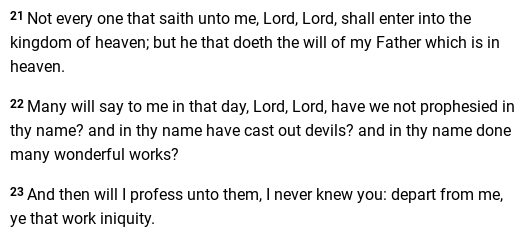
Isn't it interesting that The Lord Jesus says I never knew you to those who do not keep His commandments.
In fact, the same word the Lord Jesus uses above in Matthew 7:23 is the same word used by the Apostle Paul for those who don't keep the Lord's commandment concerning no women teaching/exercising judgement of the prophetic word in the House of God.
1 Corinthians 14:37-38- 37 If any man think himself to be a prophet, or spiritual, let him acknowledge that the things that I write unto you are the commandments of the Lord.38 But if any man be ignorant, let him be ignorant.
The word used there is agnoeó and it means not recognized or not known. Interesting, isn't it? This is exactly what the Lord Jesus tells those in Matthew who don't keep His commandments, .ie. I never knew you.
Can a female be a pastor according to the Bible? The answer is no.
Church Father table on the historical position on this modern falling-away issue:
| Church Father / Source (Date) | Summary of Position / Teaching |
|---|---|
| 1. Tertullian (c.160–225)On the Veiling of Virgins | Forbids women from speaking, teaching, baptizing, or performing any pastoral role in church. |
| 2. TertullianOn the Apparel of Women | Connects modesty and humility with women’s silence and submission in the assembly. |
| 3. Clement of Alexandria (c.150–215)Stromata 3 | Affirms spiritual equality of men and women but upholds different roles; leadership and teaching reserved for men. |
| 4. Origen (c.185–253)Commentary on 1 Corinthians | Treats Paul’s command for women’s silence as divine law, universally binding. |
| 5. OrigenHomilies on Joshua | States that even wise women should not hold teaching or leadership roles over men. |
| 6. Hippolytus of Rome (c.170–235)Apostolic Tradition | Explicitly excludes women from baptizing, teaching, or fulfilling priestly offices. |
| 7. Cyprian of Carthage (c.200–258)Epistle 74 | Declares that ordaining women violates apostolic discipline and order. |
| 8. Methodius of Olympus (d.c.311)Banquet of the Ten Virgins | Argues that God ordained male leadership and female subjection as divine order. |
| 9. Eusebius of Caesarea (c.260–339)Ecclesiastical History | Notes that apostolic succession included only men as bishops and deacons. |
| 10. Athanasius (c.296–373)Letters to Virgins | Allows women to serve in purity but forbids them from priestly or pastoral ministry. |
| 11. Basil the Great (c.329–379)Canon 44 | Orders excommunication for women who attempt to teach publicly or assume authority. |
| 12. Gregory of Nazianzus (c.329–390)Oration 37 | Teaches that men have the public teaching role; women instruct privately within the home. |
| 13. Gregory of Nyssa (c.335–395)On Virginity | Links church hierarchy to creation order, affirming male headship. |
| 14. John Chrysostom (c.347–407)Homilies on 1 Timothy | Cites Eve’s deception as reason women are not to teach or lead in church. |
| 15. John ChrysostomHomily on 1 Corinthians 14 | Distinguishes equality in nature from hierarchy in ministry; teaching implies authority reserved to men. |
| 16. Jerome (c.347–420)Epistle 52 | Recognizes women’s wisdom but restricts their teaching to private contexts. |
| 17. JeromeAgainst Jovinianus | Associates modesty and silence with proper ecclesial behavior for women. |
| 18. Augustine of Hippo (354–430)On the Trinity XII | Sees female subordination as symbolic of the Church’s submission to Christ. |
| 19. AugustineDe Genesi ad Litteram | Affirms both sexes bear God’s image but establishes male governance as divinely ordered. |
| 20. AugustineEpistle 245 | Permits private instruction by women (e.g., Priscilla) but forbids public teaching. |
| 21. Ambrose of Milan (c.340–397)On the Duties of the Clergy | Upholds male headship and restricts ecclesial authority to men. |
| 22. Ambrosiaster (4th c.)Commentary on 1 Corinthians 14 | States that teaching and authority belong to men, not women. |
| 23. Epiphanius of Salamis (c.310–403)Panarion 49 | Declares there are no priestesses in the Church; female leadership viewed as heretical innovation. |
| 24. Theodoret of Cyrus (c.393–457)Commentary on 1 Timothy | Affirms Paul’s command as permanent rule excluding women from public teaching. |
| 25. Cyril of Alexandria (c.376–444)Glaphyra on the Pentateuch | Uses Eve and Adam typology to justify male leadership in church and family. |
| 26. Leo the Great (c.400–461)Letter 14 to Anastasius | Prohibits women from assuming priestly or liturgical functions as contrary to divine order. |
| 27. Council of Laodicea (c.363–364)Canon 11 | Forbids appointment of women as “presbytides” or elders in the Church. |
| 28. Isidore of Seville (c.560–636)Etymologiae VI | Codifies that women may not preach or serve at the altar, citing apostolic tradition. |
| 29. Bede the Venerable (c.672–735)Commentary on 1 Timothy | Interprets Paul’s restriction on female teaching as universally binding. |
| 30. John Damascene (c.675–749)Exposition of the Orthodox Faith | Affirms complementary roles: men teach publicly; women learn and glorify God through obedience. |
| 31. Clement of Rome (c.96)1 Clement 40–41 | Stresses divinely ordered offices and functions within the Church. |
| 32. Ignatius of Antioch (c.110)Letter to the Smyrnaeans | Emphasizes following bishops and presbyters; male structure assumed. |
| 33. Polycarp of Smyrna (c.110–155)Letter to the Philippians | Encourages modesty and silence for women as part of church order. |
| 34. Didascalia Apostolorum (c.230) | Permits women to teach other women privately but forbids speaking or teaching before men. |
| 35. Council of Orange (441 AD)Canon 26 | Forbids women from performing priestly acts or laying on hands. |
| 36. Pope Gelasius I (494)Letter to Bishops of Lucania | Condemns reports of women serving at altars and orders correction. |
| 37. Theodotus of Ancyra (5th c.) | Restricts teaching of divine mysteries to ordained men; excludes women. |
| 38. Severian of Gabala (early 5th c.)Homily on Creation | Argues that women, having been deceived, are not suited for public teaching. |
| 39. John Cassian (c.360–435)Conferences | Views obedience and silence as the perfection of the Christian woman. |
| 40. Caesarius of Arles (c.470–542)Sermon 1 | Upholds Pauline command for women’s silence as spiritual discipline. |
| 41. Gregory the Great (c.540–604)Pastoral Rule | Implies that pastoral leadership requires masculine strength and virtue. |
| 42. Maximus the Confessor (c.580–662)Ambigua | Interprets male-female distinction as reflecting divine order in teaching and learning. |
| 43. Council of Trullo (692)Canon 70 | Commands deposition of any who ordain women to priesthood. |
| 44. Council of Nimes (394) | Prohibits admitting women to any ministry of the altar. |
| 45. Theodore the Studite (c.759–826)Epistles | Forbids women from ascending the pulpit or engaging in public teaching. |
| 46. Gelasian Decree (6th c.) | Formally bans women from ministering at the altar or holding clerical titles. |
The Sin of Women Preachers in The House of God.
Has Male Leadership Always Been God's Design Even From The Old Testament? Yes!
Did God Instruct The Apostle Paul In The Scriptures To Not Allow Woman to Pastor And Directly Forbid Them? Yes!
1 Corinthians 14:33-35
33 For God is not the author of confusion, but of peace, as in all churches of the saints.
34 Let your women keep silence in the churches: for it is not permitted unto them to speak; but they are commanded to be under obedience as also saith the law.
35 And if they will learn any thing, let them ask their husbands at home: for it is a shame for women to speak in the church.
Does the Bible allow women to be pastors?
The Apostle Paul in 1 Timothy 2:11-12 ,13-15 Forbids Female Pastors
11 Let the woman learn in silence with all subjection.
12 But I suffer not a woman to teach, nor to usurp authority over the man, but to be in silence.
13 For Adam was first formed, then Eve.
14 And Adam was not deceived, but the woman being deceived was in the transgression.
15 Notwithstanding she shall be saved in childbearing, if they continue in faith and charity and holiness with sobriety.
More About The Functioning of Pastors and Women in The House of God
Are Women Who Pastor and Preach In The Church In Disobedience To The Word of God? Yes!
Can females be pastors?
No. Females cannot be pastors in the Church. There are no female pastors in the Bible for the Scriptures forbid it.
Titus 1:4-9 Shows Paul The Apostle's Strict Direction For Godly Men as Pastors in Church Leadership, not Women.
4 To Titus, mine own son after the common faith: Grace, mercy, and peace, from God the Father and the Lord Jesus Christ our Saviour.
5 For this cause left I thee in Crete, that thou shouldest set in order the things that are wanting, and ordain elders in every city, as I had appointed thee:
6 If any be blameless, the husband of one wife, having faithful children not accused of riot or unruly.
7 For a bishop must be blameless, as the steward of God; not selfwilled, not soon angry, not given to wine, no striker, not given to filthy lucre;
8 But a lover of hospitality, a lover of good men, sober, just, holy, temperate;
9 Holding fast the faithful word as he hath been taught, that he may be able by sound doctrine both to exhort and to convince the gainsayers.
Is it biblical for a woman to be a pastor?
No. It is not biblical for a woman to be pastor. The role of pastor/elder/bishop/overseer is only given to biblically qualified men.
| Author & Source | Paraphrased Commentary / View |
|---|---|
| Matthew Henry (1662–1714) Commentary on 1 Timothy 2; 1 Corinthians 14 | Henry emphasized that women should not exercise authoritative teaching over men in church gatherings, preserving peace and order in worship. |
| John Gill (1697–1771) Exposition of the New Testament | Gill interpreted Paul’s instructions as restricting women from pastoral office and saw male qualifications as binding. |
| Richard Baxter (1615–1691) The Reformed Pastor; Christian Directory | Baxter affirmed that public oversight and governance are reserved for men while highlighting women’s vital domestic and charitable work. |
| John Owen (1616–1683) True Nature of a Gospel Church | Owen stressed that public teaching and ruling are responsibilities of ordained elders, assumed male by nature of office. |
| Jonathan Edwards (1703–1758) Sermons and letters | Edwards distinguished roles for men and women, affirming male leadership in the church while recognizing women’s nurturing and spiritual influence. |
| John Newton (1725–1807) Letters and sermons | Newton maintained that order in worship requires men to lead publicly, even as women serve in supportive spiritual roles. |
| Charles Simeon (1759–1836) Horae Homileticae; sermons | Simeon insisted that the pulpit and governance are entrusted to men, while women’s ministries are honored in other areas. |
| Samuel Miller (1769–1850) The Ruling Elder | Miller argued that elders and ministers who govern must be men with household leadership experience. |
| Charles Hodge (1797–1878) Systematic Theology | Hodge viewed Paul’s restrictions as grounded in creation order, prescribing male authority in public ministry. |
| Thomas Scott (1747–1821) Commentary on the Whole Bible | Scott saw Paul’s command regarding women’s silence in worship as universal, barring them from public teaching. |
| John Brown of Haddington (1722–1787) Expository Discourses | Brown interpreted Scripture as forbidding women from teaching or exercising authority in mixed assemblies. |
| Thomas Boston (1676–1732) Sermons and works | Boston linked creation order to church leadership, assigning teaching and governance to men while praising women’s devotion. |
| William Jay (1769–1853) Morning and Evening Exercises | Jay highlighted women’s devotion and service but reserved pastoral responsibilities for men. |
| Andrew Fuller (1754–1815) Letters and sermons | Fuller argued that women may engage in gospel witness but not exercise authority over men or hold pastoral office. |
| Ralph Wardlaw (1779–1853) Lectures on Female Influence | Wardlaw celebrated women’s moral power but emphasized that authoritative teaching roles in the church are for men. |
| Thomas Chalmers (1780–1847) Lectures on Theology | Chalmers treated pastoral leadership as a doctrinal trust for ordained men, while recognizing the importance of women’s ministries. |
| Albert Barnes (1798–1870) Notes on the New Testament | Barnes interpreted Paul’s teachings as forbidding women from authoritative public speech in worship. |
| J.C. Ryle (1816–1900) Expository Thoughts; sermons | Ryle valued women’s faithfulness and service while upholding male preaching and eldership as biblical norms. |
| Charles Spurgeon (1834–1892) Sermons; Lectures to My Students | Spurgeon asserted that preaching in the assembly belongs to men, though women’s other ministries are praised. |
| A.A. Hodge (1823–1886) Outlines of Theology | Hodge explained that spiritual gifts are shared by all but pastoral authority is reserved for men. |
| Benjamin B. Warfield (1851–1921) Princeton essays | Warfield maintained that apostolic teaching excludes women from authoritative ministry of the Word. |
| Andrew A. Bonar (1810–1892) Missionary and pastoral writings | Bonar supported women in missions while affirming male-led pastoral leadership. |
| John Keble (1792–1866) Sermons and ecclesiastical lectures | Keble defended historic clerical orders as male while celebrating women’s devotional contributions. |
| Edward B. Pusey (1800–1882) Anglican theological essays | Pusey accepted male clerical orders in Anglican tradition while acknowledging women’s influence in spiritual life. |
| John Henry Newman (1801–1890) Tracts and sermons | Newman upheld historic male clerical orders and valued women’s devotional work. |
| William Wilberforce (1759–1833) Essays and letters | Wilberforce affirmed church practice reserving pulpit authority to men, while supporting women’s spiritual service. |
| Lyman Beecher (1775–1863) Sermons and social writings | Beecher emphasized that pastoral responsibility and public oversight belong to men to maintain order. |
| Philip Doddridge (1702–1751) Family Expositor | Doddridge noted that Paul’s commands are ongoing and that public preaching by women is contrary to apostolic teaching. |
| John Angell James (1785–1859) Pastoral lectures and letters | James highlighted male pastoral responsibility while encouraging women’s edifying ministries. |
| John C. Broadus (1827–1895) Lectures on Preaching | Broadus affirmed that Scripture and tradition restrict the pastor’s office to men. |
| Horatius Bonar (1808–1889) Sermons and hymn writings | Bonar valued women’s work in mission and visitation, reserving ordained ministry for men. |
| F.C. Cook (1800s) Pastoral and ecclesiastical writings | Cook treated pastoral responsibilities for doctrine and discipline as offices to be held by men. |
| John McLeod Campbell (1800–1872) Pastoral writings | Campbell accepted male exercise of pastoral and sacramental offices while honoring women’s service. |
| Edward Irving (1792–1834) Sermons and prophetic lectures | Irving maintained that formal pastoral authority and church governance were male roles. |
| George Whitefield (1714–1770) Journals and sermons | Whitefield celebrated women’s devotion but reserved church governance and preaching to men. |
| William Williams (Pantycelyn) (1717–1791) Hymns and pastoral letters | Williams praised women’s evangelistic labors but assumed ordained ministry as male. |
| John Kitto (1804–1854) Biblical Encyclopaedia | Kitto reflected the consensus that eldership and the pulpit are male offices. |
| Legh Richmond (1772–1827) Parish writings | Richmond affirmed the pastorate as male while praising women’s devotion in parish life. |
| John Flavel (1627–1691) Practical Divinity | Flavel held that women should not speak authoritatively in the congregation and serve in other pious spheres. |
| Thomas Watson (1620–1686) The Godly Man’s Picture | Watson advocated female humility and domestic instruction rather than public pulpit authority. |
| Samuel Rutherford (1600–1661) Letters; ecclesial writings | Rutherford defended male eldership and public teaching offices for ordained men. |
| Thomas Goodwin (1600–1680) Works on church government | Goodwin saw public teaching and ordination as male offices in line with apostolic instruction. |
| Stephen Charnock (1628–1680) Discourses on Divine Attributes | Charnock emphasized orderly church life with male-led eldership and regulation of public speech. |
| John Howe (1630–1705) Sermons and practical divinity | Howe treated pastoral teaching and eldership as male responsibilities. |
| William Perkins (1558–1602) Practical divinity and commentaries | Perkins advocated male pastoral authority in public worship. |
| William Bates (1608–1660) Sermons and writings | Bates emphasized Puritan order and male-led pastoral oversight. |
| John Brinsley (1600s) Pastoral writings | Brinsley argued that preaching and pastoral duties are male responsibilities. |
| Increase Mather (1639–1723) Sermons and ecclesiastical writings | Mather treated eldership and pulpit oversight as male responsibilities in practice. |
| Cotton Mather (1663–1728) Sermons and ecclesial essays | Mather followed New England Puritan norms reserving public pastoral leadership for men. |
| Thomas Fuller (1608–1661) Church history and sermons | Fuller accepted male pastoral oversight as normative in church life. |
| Nathaniel Ward (1578–1652) Christian Commonwealth | Ward reflected male-led church governance in ecclesial legislation and practice. |
| John Colquhoun (1698–1765) Pastoral works | Colquhoun emphasized male eldership and pastoral responsibility in parish contexts. |
| Thomas Binney (1798–1874) Sermons and lectures | Binney treated the pastorate as a male office while recognizing women’s supportive ministries. |
| Joseph Hall (1574–1656) Sermons and ecclesiastical writings | Hall maintained male clerical authority in public worship. |
| Richard Sibbes (1577–1635) Works and sermons | Sibbes upheld ordered worship with male oversight in assemblies. |
| John Calvin (1509–1564) Institutes; commentaries | Calvin structured elders and pastors as male offices, influencing later Protestant practice. |
| Martin Bucer (1491–1551) Reformation writings | Bucer’s ecclesiology limited ordained ministry to men and shaped later authors. |
| J.A. Trench (1800s) Sermons and essays | Trench upheld male-led pulpit ministry in Anglican contexts. |
| Edward Williams (1750s–1820s) Sermons | Williams reinforced male pastoral authority through pastoral instruction. |
| John Erskine (1721–1803) Sermons and theological discourses | Erskine emphasized male public teaching and oversight in church assemblies. |
| Thomas Adams (1583–1652) Pastoral treatises | Adams assigned preaching and worship regulation to ordained men. |
| Hugh Binning (1627–1653) Sermons and theology | Binning presupposed male eldership and pastoral leadership in church order. |
| Alexander Whyte (1836–1921) Sermons and lectures | Whyte upheld male pastoral responsibility in Presbyterian contexts. |
| Robert Murray M’Cheyne (1813–1843) Sermons and diaries | M’Cheyne valued women’s spiritual work while maintaining male-led pastoral oversight. |
| William Romaine (1714–1795) Sermons and pastoral works | Romaine taught ordered worship and male pastoral office in evangelical contexts. |
| Edward Bickersteth (1786–1850) Sermons and pastoral guidance | Bickersteth emphasized male pastoral oversight and clerical leadership. |
| Thomas Guthrie (1803–1873) Sermons and social writings | Guthrie advocated male pastoral leadership in parish reform and outreach. |
| Alexander Maclaren (1826–1910) Sermons and expositions | Maclaren treated pastoral authority and family headship as male responsibilities. |
| William Arnot (1808–1875) Sermons and writings | Arnot maintained that ordained preaching offices were reserved for men. |
Question: Should I Leave A Church with A Woman Pastor?
Should you leave a church with a woman pastor? The answer is yes. A woman as a pastor in the House of God is a clear violation of Scripture and the Lord is vehemently opposed to it.
See the Lord Jesus words in Revelation 2:20-23 (New Testament)
20 Notwithstanding I have a few things against thee, because thou sufferest that woman Jezebel, which calleth herself a prophetess, to teach and to seduce my servants to commit fornication, and to eat things sacrificed unto idols.
21 And I gave her space to repent of her fornication; and she repented not.
22 Behold, I will cast her into a bed, and them that commit adultery with her into great tribulation, except they repent of their deeds.
23 And I will kill her children with death; and all the churches shall know that I am he which searcheth the reins and hearts: and I will give unto every one of you according to your works
Let's look at the arguments used in suport of woman pastors with Scriptural answers
Question: Doesn’t Galatians 3:28 teach that men and women are equal in all church roles, including pastoral leadership?
Answer: No. Galatians 3:28 states, “There is neither Jew nor Greek, slave nor free, male nor female, for you are all one in Christ Jesus.” This passage addresses salvation and spiritual standing before God, not church governance or teaching authority. Paul consistently maintains distinct roles in church leadership, instructing that women should not exercise authority over men in the congregation (1 Timothy 2:12; 1 Corinthians 14:34–35). Scholars explain that equality in Christ pertains to spiritual value, not functional authority in church offices (Fee, 1 & 2 Corinthians, 1987; Grudem, Systematic Theology, 1994).
Question: But the Bible shows examples of female leaders like Deborah and Priscilla. Doesn’t that prove women can be pastors?
Answer: Not exactly. Deborah (Judges 4–5) served as a judge of Israel, which was a civil and judicial role, not a pastoral office as defined in the New Testament. Priscilla (Acts 18:26) taught Apollos, but she did so in partnership with her husband, not as the sole authority over a congregation. These examples are context-specific exceptions, and they do not overturn Paul’s clear instructions about the roles of women in Church leadership (Bauckham, Gospel Women, 2002; Lightfoot, St. Paul’s Epistles to the Galatians, 1865).
Question: Isn’t Paul’s restriction on women just a cultural rule for the 1st-century church?
Answer: No. Paul grounds his instructions in the creation order (1 Timothy 2:13–14), referencing Adam and Eve to establish God’s design for gender roles. While cultural customs may vary, the principle of male leadership in teaching and authority over men is timeless and theological, not merely social (Grudem, Systematic Theology, 1994; Schreiner, 1, 2 Timothy, Titus, 1990).
Questions: What if a woman is spiritually gifted to teach? Doesn’t gifting override gender?
Answer: Spiritual gifts do not override God’s design for church leadership roles. Women can exercise gifts like teaching, prophecy, and ministry, but these gifts must operate within the boundaries set by Scripture. Paul’s instructions aim to protect God-ordained order and ensure that men exercise leadership faithfully without ceding authority to women over them (1 Timothy 2:12; MacArthur, 1 Timothy, 1995; Piper & Grudem, Recovering Biblical Manhood and Womanhood, 1991).
Question: Didn’t Old Testament female leaders, like Huldah, show God approves of women in leadership?
Answer: Huldah (2 Kings 22:14–20) was a prophetess, not a pastor or elder of a congregation. Old Testament prophetic or civil roles are distinct from New Testament pastoral offices. Paul’s instructions (1 Timothy 3:1–13; Titus 1:5–9) specifically define pastoral qualifications as male, indicating that OT examples do not provide precedent for women leading congregations over men (Fee, 1 & 2 Timothy, 1988).
Are There Quick Facts from The Bible On The Topic For Women?
What does the New Testament say about Female Pastors?
There are no female or woman pastors in the Bible. Women are not permitted to be preachers in the assembly according to 1 Corinthians 14:33-35
- The Lord Jesus Christ nowhere in Scripture chose a female leader or apostle. Leadership in the Church, which follows the creation order between man and woman, according to 1 Timothy 2:11-12, 1 Timothy 3:1-3 and 1 Corinthians 14:33-35, is male. It is not female.
The Lord Jesus Christ is the man and The Church is the woman. He is the image of God and we have only one teacher, God. How can God, represented by the Lord Jesus Christ be taught by the woman, the Church? No. God teaches the Church, therefore the man teaches the woman, the woman does not teach the man. This is the order of God in the Church of God, which according to 1 Timothy 2 &3 is the household of God.
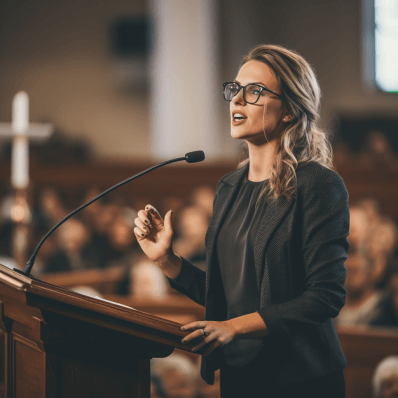
The basis for prohibitions against women pastors are found in 1Corinthians 14:34 and 1 Timothy 2:11-12.
Women do have wonderful teaching abilities. The older women are told to instruct the younger women in Titus. The men are to have the leadership/governmental roles in the Church according to Titus 1:4-9.
Women should teach within the boundaries given by God's Word in Titus 2:3-8 and not in contradiction to clearly outlined Scripture.
It is known in the Bible that 1 Timothy 2:12 forbids a woman to be a senior pastor or any kind of pastor or overseer in the House of God for the overseer must be the husband of one wife.
For a woman to pastor, she has to become a husband, in clear contradiction to Scripture for she she should not put on that which pertains to the man. The Bible says that all who do so are an abomination to the Lord in Deuteronomy 22:5.
The Lack of Priestesses, (priests being the male equivalent of pastors in the New Testament church) is a defining difference in the worship of Almighty God by the Jews. Could this be why the apostle Paul in the New Testament reaffirms this position when talking about worship, and The Lord Jesus in Revelation likens the female teacher, the woman Jezebel in the Church to the sin of Idolatry?
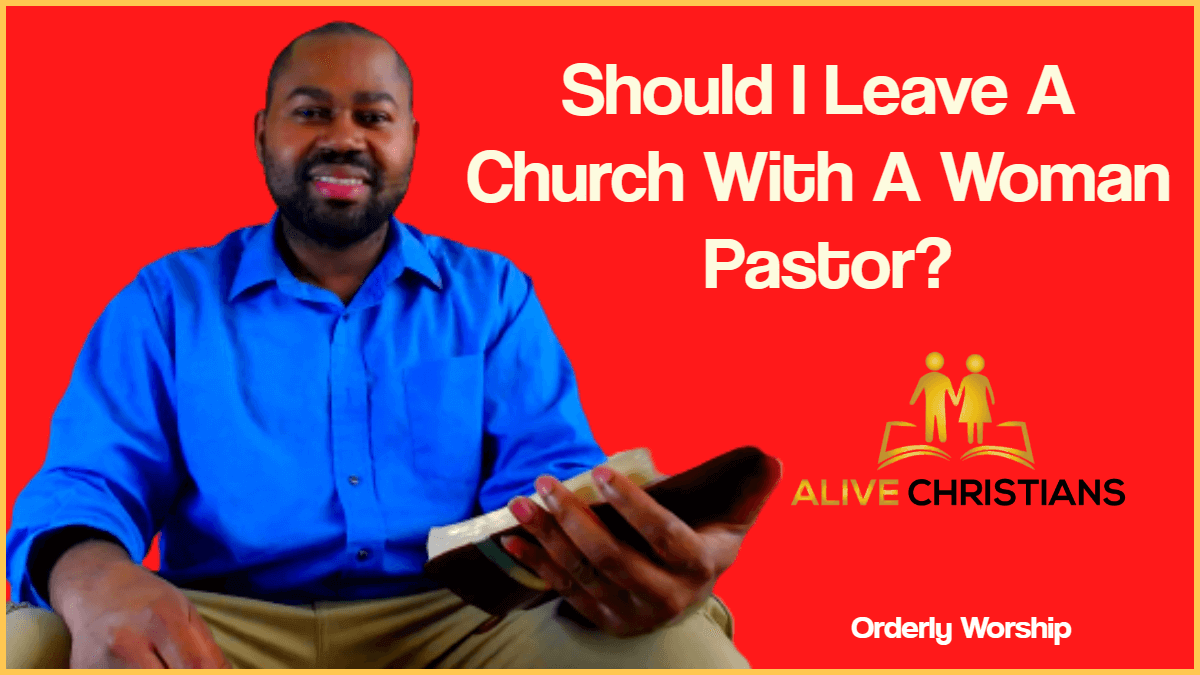
Look at what Torah.com has to say about women priests or priestesses:
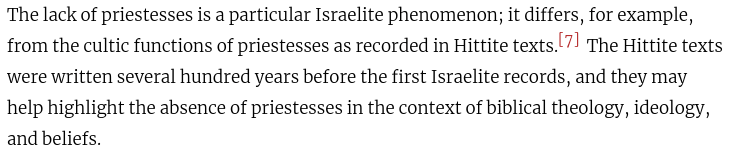
Having No Priestesses was a Defining Trait of Israelite Worship, just as it is in the Church for when the Apostle mentions the topic of worship in 1 Timothy he goes first and foremost to gender roles!
Your gender is not irrelevant like the culture may want you to believe. Your gender was created by God for His purposes, and He shares in His Word what He desires each gender to do for Him. To go against clearly outlined scripture is rebellion and as the sin of witchcraft.
Secondly, there is no trace of women being ordained as pastors in a "church" until the 1800s!
The modern phenomenon of women pastors and women preachers in the House of God is clearly contradictory to the Holy Scriptures. Clearly, the phenomenon of woman pastors is a part of the great falling away mentioned in 2Thessalonians2:1-3, and the time when people shall not endure sound doctrine.
Can a female become a pastor? NO.
Women preachers and women pastors in the House of God is a sin, and clearly contradicts the Lord's explicit commandments in 1 Corinthians 14:34-38, Genesis3:16, 1Timothy 2:11-12, and anyone who does this or supports this is in danger of great tribulation except they repent according to Revelation 2:22.
Want More Biblical content? Click below.