
Table of Contents
When we look at verse four of How great thou art, it takes us into the Savior aspect of the song.
So first we see The Creator aspect, and now we see The Savior aspect.
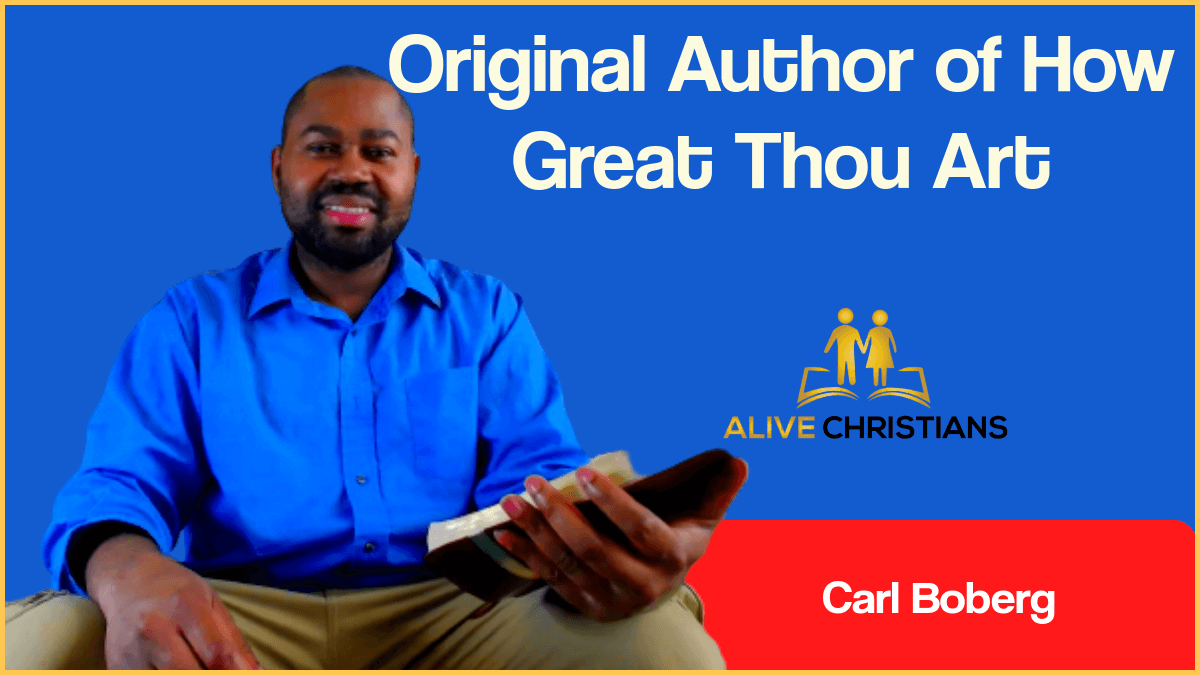
And he says, When Christ shall come with shout of acclamation and take me home, what joy shall fill my heart. Here, Carl Boeberg is sharing with us the joy of being a believer, the expectation and hope that we have in Christ, as Scripture shares, we shall come with him and as he is, so shall we be, and we shall be like Him.
Now there is a joy that comes with this expectation of victory and confirmation, that the One whom we believe but did not see is the One that we shall see, and we shall indeed hear with our ears.
The songwriter goes on and he says, Then I shall bow in humble adoration, and there proclaim My God, how great Thou art.
This is paralleling the Apostle Thomas' statement, My Lord and my God. And here the songwriter is sharing the sentiment of being awestruck by the majesty of God in that He saved us, this Amighty God that will burst through the clouds and bring this triumphant entry is the same one that took the time to save you and me.
Here are hymnologists on the theology and doctrinal impact of the hymn.
| Hymnologist & University / Affiliation | 3-Sentence Theological / Doctrinal View on “How Great Thou Art” |
|---|---|
| Carl Gustav Boberg (Swedish poet) | Boberg wrote the hymn inspired by the majesty of God’s creation, expressing awe and worship. His lyrics emphasize God’s omnipotence, care, and providence over humanity. The hymn reflects personal devotion rooted in scripture and reverence for divine glory. |
| John Julian (Pastor, London) | Julian highlighted the hymn’s biblical imagery, especially its echoes of Psalms 8 and 19. He saw it as a faithful expression of God’s omnipotence and grace. The hymn reinforced traditional Christian doctrines through poetry and music. |
| Stuart K. Hine (missionary, early exposure in Ukraine) | Hine began adapting the hymn for English-speaking audiences, emphasizing God’s greatness and redemption. He preserved the theological essence of Boberg’s original work. His efforts laid groundwork for wider congregational worship. |
| Ralph Vaughan Williams (Cambridge University, composer) | Vaughan Williams noted the hymn’s adaptation of folk melody for congregational use. He emphasized the role of music in teaching and reinforcing theological truths. The hymn’s melody makes doctrine accessible and memorable. |
| Harry T. Burleigh (Oberlin College) | Burleigh stressed the hymn’s musical conveyance of divine majesty. He highlighted its accessibility for diverse congregations while maintaining doctrinal depth. Hymns like Boberg’s demonstrated the union of theology and art. |
| Felix Mendelssohn (Leipzig Conservatory) | Mendelssohn admired hymnody that expressed awe of God through music. He emphasized harmonies that elevate worship and illustrate divine glory. His approach influenced the way congregations internalized doctrine through melody. |
| Charles Villiers Stanford (Royal College of Music, London) | Stanford highlighted hymn tunes as vehicles for doctrinal teaching. He emphasized musical settings that reinforce scriptural truths. The hymn exemplifies worship informed by theology and artful composition. |
| H. R. Haweis (Clergy, London) | Haweis underscored the spiritual and moral power of hymns. He emphasized their role in instilling reverence and doctrinal understanding. “How Great Thou Art” reflects these principles in its combination of lyric and devotion. |
| E. W. Bullinger (Clapham, London) | Bullinger highlighted the hymn’s eschatological and creation-based theology. He emphasized God’s sovereignty and providential care as central doctrinal themes. The hymn instructs believers in both worship and scriptural reflection. |
| John Stainer (Oxford University) | Stainer emphasized the integration of hymn lyrics with musical composition for doctrinal teaching. He noted how melody aids congregational comprehension of theological truths. Hymns like Boberg’s illustrate reverence and doctrinal instruction. |
| Sabine Baring-Gould (Exeter University) | Baring-Gould analyzed hymn lyrics for doctrinal clarity and devotional power. He emphasized natural theology and divine glory reflected in creation. His work validates hymns as a means of instructing faith while inspiring worship. |
| F. J. Crosby (American hymn writer) | Crosby highlighted hymns as tools for personal devotion and doctrinal instruction. He emphasized clear exposition of God’s majesty and providence. “How Great Thou Art” aligns with this purpose, teaching theology through song. |
Songs like Blessed Assurance, What a Friend We have in Jesus and other hymns like these are frequently coupled with How great Thou Art when singing this hymn.
Bible Verses About Praise and Worship (Powerful)
We hope that you've enjoyed this deep dive into How Great Thou Art.
Verse 4 of How Great Thou Art
When Christ shall come, with shout of acclamation,
And take me home, what joy shall fill my heart.
Then I shall bow, in humble adoration,
And then proclaim: "My God, how great Thou art!"
Then sings my soul, My Saviour God, to Thee,
How great Thou art, How great Thou art.
Then sings my soul, My Saviour God, to Thee,
How great Thou art, How great Thou art!